How to Choose an EMR Data Migration Partner
A bad EMR migration can paralyze your clinical operations, expose sensitive patient data, and derail your timeline. That is why choosing the right EMR data migration partner is one of the most critical decisions your organization will make. Most importantly, this choice cannot rely on sales pitches or bargain rates. Instead, you should look for proven, real-world capability.
Drawing from SCIMUS’s hands-on experience helping healthcare organizations with EMR migration services, this guide cuts through the marketing noise. You will learn what key factors drive migration success, the exact questions to ask potential vendors, and get a clear framework to evaluate any partner against your project’s specific needs.
Why Choosing the Right EMR Migration Partner Matters
The most common error made when planning healthcare data migration services is treating the transition as a purely technical file transfer. You can see what we mean by reading through a 2026 case study in JMIR Formative Research that followed an 11-physician primary care organization in Peterborough, Ontario, through a full EMR migration. The team interviewed the lead physician, the lead administrator, nine family physicians, twelve interprofessional health providers, and nine medical office assistants about the challenges they faced.
Participants described the project as “a resource-intensive organizational transition shaped by unpaid preparation work, cost pressures, clinical governance, quality assurance, and the responsiveness of stakeholders, particularly the vendor.”
That directly affects vendor selection, as you will often encounter companies that only scope file extraction and loading. In that case, the rest of the work falls to your staff, who are often unprepared and not trained to manage it.
EMR Migration: Clinical & Operational Transition Beyond Data Transfer
OntarioMD’s migration guidance draws the same distinction. It separates EMR migration, meaning the whole transition, from data migration, meaning the movement of information.
In essence, it all boils down to how the vendor works with the data. Most vendors can transfer both electronic health records (EHR) and electronic medical records (EMR) in whatever format, following basic information-transfer procedures.
However, errors in this type of transition can affect patient well-being and treatment. Therefore, the healthcare data migration company you partner with must prove the transferred records are correct, complete, and usable on your platform. This kind of transition requires a broader scope that covers:
- Data conversion
- Workflow redesign
- Training
- Change management
- Quality assurance
- Physician leadership
- “Invisible” staff work
- Ongoing vendor coordination
Physician-led governance and allotting time for training, QA, and staged validation are essential to your success. Planning for that is on your side, so you should be prepared for it. You can also use this as an opportunity for vendor assessment. An EMR migration partner with real expertise will understand these challenges and estimate your collaboration at every level, not merely data transfer.
The Cost of Getting Migration Wrong
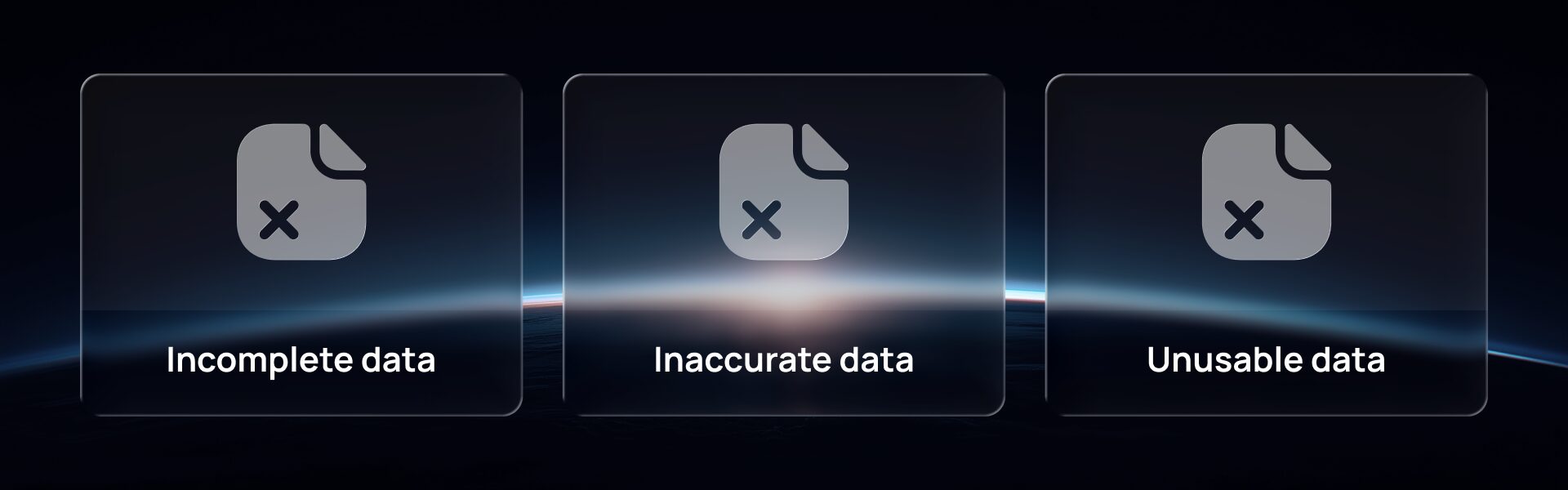
A wrong decision when choosing a medical data migration company can have direct consequences for the business, from reduced productivity to loss of trust from affected patients. Most common issues with this transition include:
- Incomplete data: some patient records are missing, for example, immunization history.
- Inaccurate data: the transfer was complete, but some values were assigned to the wrong fields, such as records assigned to the wrong patient or improperly converted units.
- Unusable data: records that migrated but your system cannot use, for instance, a scan file your platform cannot process.
To manage the risks of healthcare data migration, you and the vendor you work with must have a plan that covers:
- What could go wrong
- What action will be taken
- Who owns that action
- What the consequences/costs would be if migration isn’t 100% successful
Some of the most effective tools that minimize the risks are:
- Backups
- Rollback procedures
- Test migrations
- Downtime plans
- Escalation contacts
- Issue tracking
- Validation checkpoints
- Post-go-live support
Reliable EHR migration services must account for all of these. This means the vendor should explain how they’ll handle each step to keep the process as smooth and safe as possible.
6 Criteria for Choosing an EMR Data Migration Partner
Most comparison guides will tell you to look at the vendor’s experience, security, and rates. That advice is sound but also almost useless, because every vendor claims to have the best of everything. The criteria below are framed around what you can actually verify.
| Criterion | Why It Matters | What To Verify |
| Healthcare and clinical data experience | General data migration skills don’t transfer. Clinical meaning hides in schema differences | Knowledge of problem lists, medication records, and where clinical risk sits;Comparable project history |
| Source and target system expertise | A strong healthcare portfolio says little about your specific pairing | Named experience with both platforms;Extraction method from your source, ingestion route into your target |
| Mapping, transformation, and cleansing | Mapping is integral for maintaining data accuracy and completeness | Field alignment, code conversion, unit normalization, date handling, duplicate resolution;A sample mapping specification |
| Validation and QA | “We test the migration” means little if you don’t understand what gets tested | Three levels: record counts and totals, field-level source-to-target comparison, clinician review of migrated data |
| Security, privacy, and compliance | Your partner becomes a business associate handling protected health information | Business associate agreement, data encryption in transit and at rest, access controls on staging, retention and destruction policy, audit logs |
| Post-migration support and ownership | The first weeks after go-live are an extension of QA | Issue log, named escalation paths, willingness to reload incorrectly migrated data |
Healthcare and EMR Migration Experience
“Check experience” is the first recommendation you’ll see in any “how to choose an EMR migration company” guide. You definitely should follow it and look through the vendor’s case studies. In addition, you should request additional details on the relevant projects to get a better understanding of your potential partner’s expertise.
Experience With Your Source and Target EMRs
Another key factor is EMR interoperability. You need to understand that not all systems that handle this data are equal. Therefore, your partner must not only have the expertise to manage the transition overall but also understand both systems involved. For example, extracting data from a self-hosted installation requires a different process than pulling it from a third-party cloud. Some topics to discuss with your migration vendor include:
- How data is extracted from the source
- What export options are available
- Which source fields are accessible
- What the target system accepts
- Which fields require transformation
- Which data cannot be migrated
- Which data becomes structured vs. document-based
- How custom fields/templates are handled
- How historical data is treated
Data Mapping and Transformation Capabilities
EMR data mapping is a complex process that must account for all details needed for a complete, accurate transfer. This is the process you should expect an experienced vendor to follow:

Note that mapping can involve:
- Field mapping
- Code conversion
- Terminology normalization
- Date/time conversion
- Unit normalization
- Patient identity matching
- Document classification
- Relationships between records
- Structured/unstructured conversion
- Duplicate handling
- Exception handling
With such a broad scope of EMR data conversion, verify that the vendor can handle the procedures at every level by asking pointed questions and requesting specific details during your interviews.
Data Validation and QA
The validation stage is where you address, or ignore, the missing-versus-wrong data asymmetry. NHS England’s guidance describes checking as an initial review followed by rechecking after suppliers fix what the first pass found. Remember, one round isn’t enough for satisfactory validation. Therefore, your EMR data migration services vendor must be ready and willing not only to rerun the checks but also to make changes if any issues are identified.
Usually, there should be three levels of validation:
- Technical: checking details such as record counts and duplicates
- Field: checking if all field values match after data transformation
- Clinical: designated staff inspect migrated data (preferably side-by-side with the old records)
Security & Compliance
Security has become a major consideration in healthcare and one of the biggest EHR migration challenges. HIPAA Journal’s analysis of federal breach data found business associates involved in 43% of large healthcare breaches in the first half of 2026, against a 20% average between 2009 and 2017. So, when choosing a vendor, don’t stop at asking whether they provide HIPAA-compliant software services.
The following questions should help guide you:
- Will the vendor sign a BAA?
- Where is migration data temporarily stored?
- Is data encrypted in transit and at rest?
- Who has access to staging environments?
- Is access role-based?
- Are migration activities logged?
- How long are working copies retained?
- How are temporary files destroyed?
- What happens to backups?
- What is the incident-response process?
- What security responsibilities belong to the client versus the migration partner?
Post-Migration Support
Support post-transition is a mandatory item on any EMR migration checklist because you must be confident the vendor will manage any issues that arise as the system matures. This should be considered a part of quality assurance for the service and cover resolving issues such as:
- Missing records
- Incorrect mappings
- Duplicate patients
- Document-linking problems
- User questions
- Workflow problems
- Correction/reload requests
- Escalation to the target EMR vendor
- Overall monitoring
How to Compare EMR Migration Partners
It’s impossible to name the “best EMR migration company” because such labels are subjective. In fact, any vendor that positions itself that way should raise suspicion, and you should check whether it can back up its claims. Comparing quotes will only get you so far because, in this case, expertise matters most.
Here are some questions to ask an EMR migration vendor to verify they are indeed experts in this niche.
| Question | What It Tests | Evidence to Request |
| Can you run a sample migration using representative records from our current EMR before we sign? | Whether capability is real or asserted | Completed sample with results you can inspect |
| Exactly which data types will migrate, and which won’t? | Scope honesty | Written scope listing inclusions and exclusions |
| How are fields, codes, and units mapped between systems? | Technical depth | Sample mapping specification |
| Which data arrives as structured records, and which as documents? | Whether migrated data stays usable | Field-level breakdown by data type |
| How do you match patients and resolve duplicates? | Readiness for consolidation work | Documented matching and approval process |
| How do you manage EMR migration downtime? | Continuity planning | Cutover plan with a stated downtime assumption |
| What happens if the migration doesn’t go according to plan? | Maturity under failure | Rollback and contingency plan, backup strategy |
| Where does our data sit during migration, and who can access it? | Protected health information handling | Business associate agreement, access and retention policy |
| Who confirms the migrated charts are correct? | Accountability for accuracy | Acceptance criteria and sign-off process |
| What happens in the first month after go-live? | Support reality | Service levels, escalation contacts, issue log |
What a Good EMR Migration Process Should Look Like
From experience, we know no two clinical data migration projects are the same. You can see how they can play out by looking at these real examples:
MedMerger was a proof of concept we did for a private-equity-backed group consolidating acquired practices into a standardized EMR platform, Athena. We built a schema-agnostic mapping layer and an automated extract, transform, and load pipeline, then delivered a working platform in two weeks. The ModMed-to-Athena migration achieved 100% core data coverage and zero data-loss incidents.

Splice Health extended the same framework across 17 practices and 10 source systems. Those included eClinicalWorks, Practice Fusion, AllScripts, and MD Logic. Each migration averaged under 30 days, moving 140,000+ records with 99.9% data accuracy. Reusing a proven mapping layer, rather than rebuilding one per system, made that repeatable.

EMERGE moved 300,000+ patient records and roughly 3 TB of clinical documents from a self-hosted eClinicalWorks environment into Athena across multiple live locations. Our team sequenced the work around upcoming appointments, so each chart was ready before the patient’s next visit, and no location paused operations. We collapsed duplicate records and repaired broken data links during transfer, so the practice went live with cleaner data than it left.

We’ll be honest, none of that makes us the right fit for every organization. However, you can trust us to be honest when preparing a quote and discussing your project. If you are looking for transparency, professionalism, and expertise from an EMR data migration partner, book a scoping call with SCIMUS.