About the Client
The client is a large, multi-location medical practice running eClinicalWorks (eCW) in a self-hosted configuration — its entire clinical history held on the practice’s own servers, distributed across several physical sites. With hundreds of thousands of patient records and a high daily volume of care across locations, it represented exactly the kind of enterprise environment where a migration carries the greatest risk and the least room for error.
As part of its move onto a standardized Athenahealth platform, the practice needed its full dataset migrated from self-hosted eCW into Athena: more than 300,000 patient records, accompanied by roughly three terabytes of clinical documents. The constraint was absolute — not one of its locations could afford to pause operations. Patients would continue to be seen, appointments kept, and clinicians working throughout, which meant a migration of enormous volume had to happen around a fully functioning practice rather than during any window of downtime.
Enormous Volume, a Live Practice, and No Room for Error
- The difficulty here was never whether the data could be moved — it was moving an enormous volume out of a self-hosted system, across several active locations, without anyone in the practice noticing it was happening. A migration of this size would normally justify a maintenance window or a weekend freeze. This one had none.
- Every dimension of the project pushed against the next: the more data there was to move, the more tempting a downtime window became — yet downtime was precisely what the practice could not allow. The work had to be large, careful, and invisible all at once.
- Key challenges included:
- 1. A massive volume of documents. Roughly three terabytes of scanned charts, faxes, and clinical files made up the bulk of the migration — far heavier and slower to extract, transfer, and verify than the structured records themselves.
- 2. Extraction from self-hosted eCW. With the data held on the practice’s own servers rather than a vendor cloud, the team had to work directly against live infrastructure to pull it safely, without straining systems that were in constant daily use.
- 3. Multiple live locations at once. This was not one system to migrate around but several, each seeing patients on its own schedule — so continuity had to hold across every site simultaneously.
- 4. Zero tolerance for downtime at scale. A dataset this large would normally call for a cutover window. The practice couldn’t pause for one, so a big-bang migration was off the table from the start.
- 5. Integrity across a massive dataset. With 300,000+ records and millions of document files, every item had to arrive in Athena complete and matched to the right patient. At this volume, even a tiny error rate would mean thousands of mistakes.
- 6. Duplicate records and broken data links. Years of operation across multiple locations had left significant duplication — the same patient recorded more than once — alongside missing or broken links between related records. The data couldn’t simply be moved as-is; it had to be deduplicated and repaired in flight, so the practice arrived in Athena with a cleaner dataset than it left with.
An Incremental Migration That the Practice Never Felt
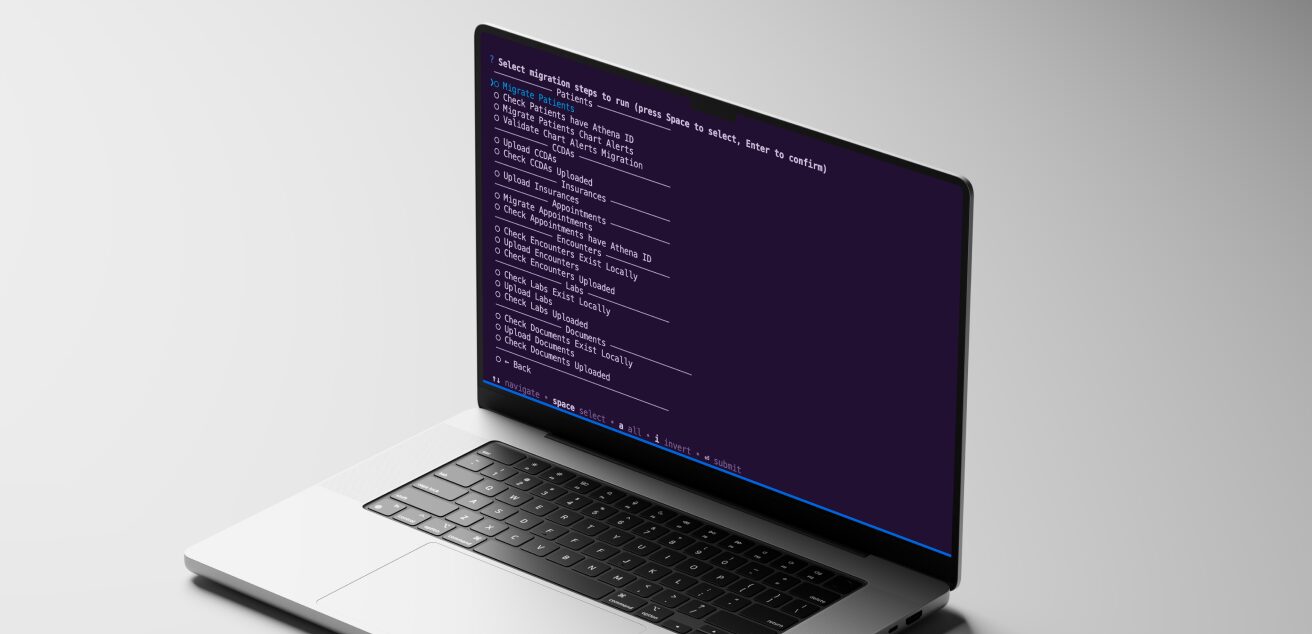
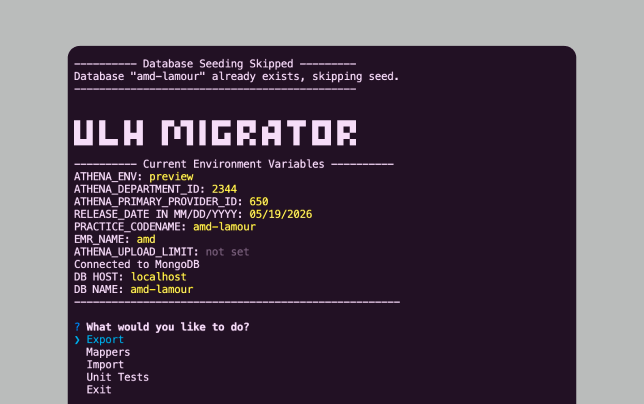
Rather than move 300,000 records and three terabytes of documents in one disruptive cutover, SCIMUS migrated the practice in motion — letting the upcoming appointment schedule set the order, so every patient’s full chart was ready in Athena before their doctor next saw them..
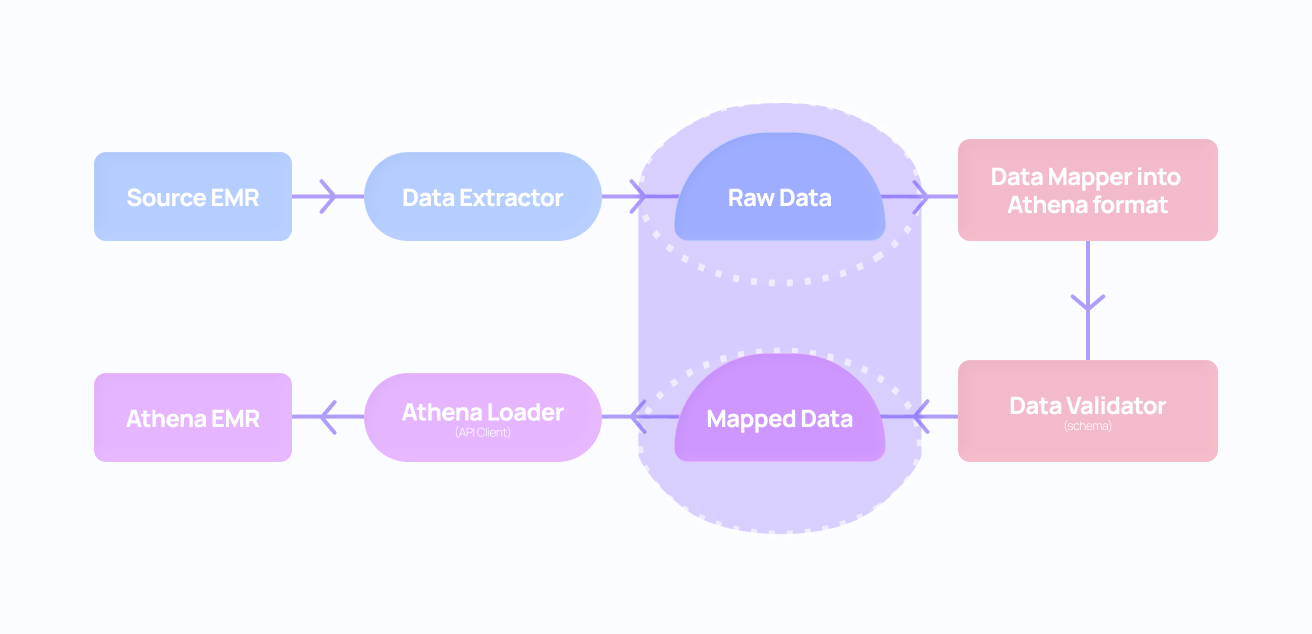
The core of the approach was to abandon the idea of a single migration event altogether. Historical data was extracted from the self-hosted eCW environment and loaded into Athena steadily in the background, at a pace the practice’s live systems could absorb without strain. Because nothing depended on a hard cutover, there was never a moment when a location had to stop working.
What we delivered:
- Appointment-Driven Migration Planning
- Priority-Based Patient Record Migration
- Incremental Background Data Transfer
- 3 TB Document Migration
- Point-of-Care Data Availability
- Data Deduplication & Record Reconciliation
- Data Quality Improvement During Migration
- Multi-Location Athena Go-Live Support
- Zero-Downtime Transition
The Team of Success
A duly-designed — meaning cost-efficient and result-oriented — team was assigned to the project
How the Zero-Downtime Migration Worked