Modern self-service health portals are reshaping how patients manage their care. These secure digital tools allow users to access medical records, book appointments, refill prescriptions, and handle billing - all without phone calls or paperwork. Patients now expect healthcare portals to match the ease and efficiency of consumer apps, with features like real-time updates, intuitive design, and 24/7 access.
Here’s what patients prioritize in health portals:
- User-Friendly Design: Simple navigation, tutorials for older or less tech-savvy users, and accessibility for those with impairments.
- Medical Record Access: Anytime access to medications, lab results, and clinical notes, with a focus on privacy and security.
- Appointment Scheduling: Real-time booking, automated reminders, and options for virtual visits.
- Prescription Management: Easy refill requests, medication tracking, and adherence tools.
- Billing Clarity: Secure payments, expense tracking, and insurance claim updates.
Providers are also integrating advanced features like telehealth, remote monitoring, and AI-driven personalized recommendations. These tools improve patient engagement while maintaining compliance with strict data privacy laws like HIPAA.
Why it matters: Patients demand convenience, transparency, and security in their healthcare experience. Meeting these expectations requires tailored, well-tested portals built for modern needs.
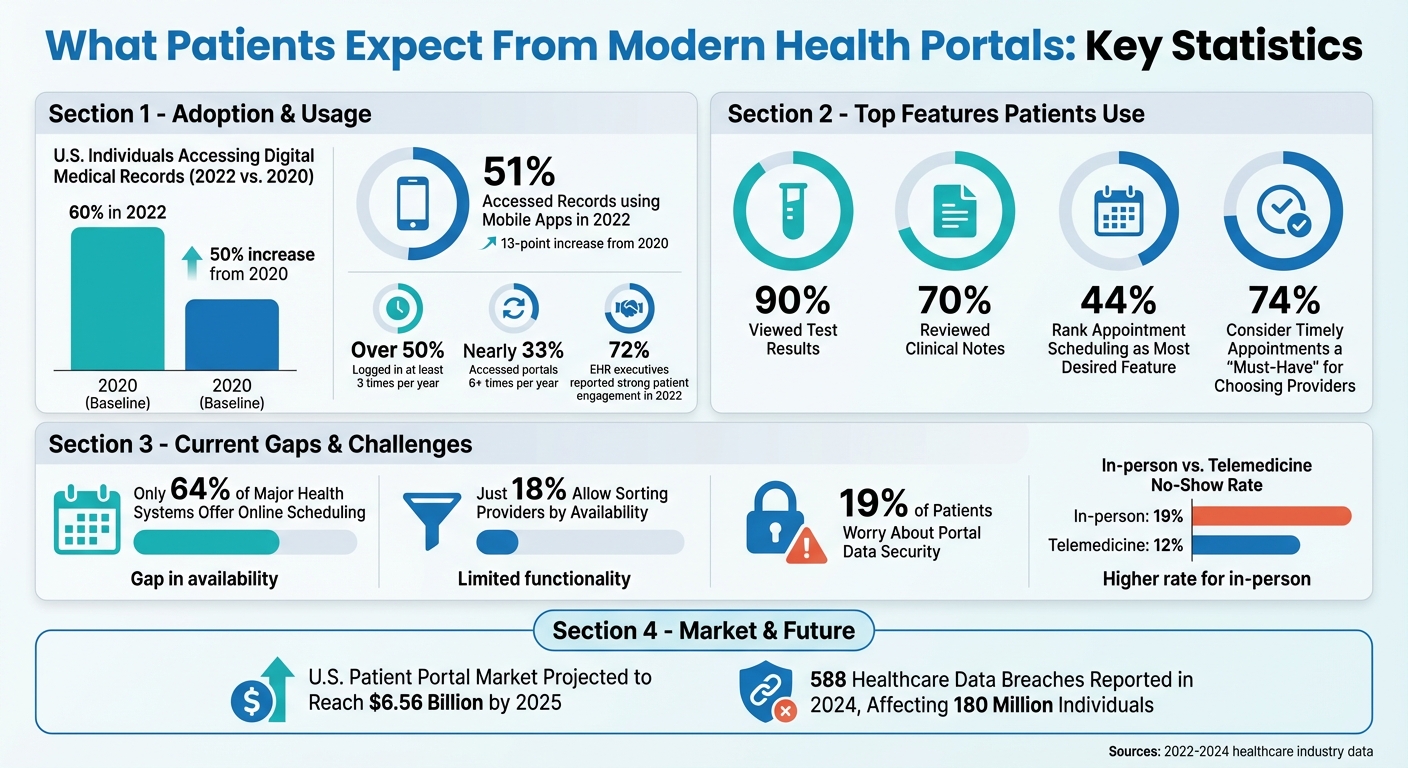
Patient Portal Usage Statistics and Key Features 2022-2024
Core Features Patients Want in Health Portals
Simple, Accessible Design
Patients expect health portals to feel as intuitive as the apps they use daily. This means responsive design that works smoothly across smartphones, tablets, and desktops, paired with straightforward navigation. Even the registration process should be hassle-free, addressing common challenges like two-factor authentication, which can be tricky for older users.
For portals to truly serve everyone, they need to accommodate diverse patient groups. Older adults and those less familiar with technology benefit greatly from features like brief tutorials and step-by-step instructions. Accessibility is also key - designs must adhere to standards that support users with visual, hearing, or motor impairments. These thoughtful design choices not only make portals easier to use but also encourage higher engagement across the board.
24/7 Access to Medical Records
Access to medical records anytime, anywhere, has become a baseline expectation. Patients want to view medications, lab results, discharge summaries, immunizations, allergies, and clinical notes whenever they need, whether through a browser or an app. In fact, by 2022, three out of five people in the U.S. had accessed their medical records online.
That said, protecting sensitive information is just as important as accessibility. Many portals implement provider validation for certain records to strike a balance between transparency and security. The healthcare industry has also made strides in data sharing, thanks to the Cures Act Final Rule of 2020. Interoperability standards like HL7 FHIR now allow systems to exchange data seamlessly, giving patients a more complete view of their health history.
Easy Appointment Scheduling and Management
When it comes to health portals, appointment scheduling is a top priority. Nearly half (44%) of patients rank it as their most desired feature. Tools like real-time scheduling and interactive calendars let patients book appointments quickly from any device, sparing them the frustration of phone calls and long hold times. However, a 2024 audit showed only 64% of major health system websites offer online scheduling, and just 18% let users sort providers by availability.
This gap between what patients want and what’s available can be frustrating. Features like automated reminders help reduce missed appointments, while digital intake forms save patients from repeatedly filling out the same paperwork. Portals that support both in-person and virtual visits, along with advanced search options for finding providers by availability and location, cater to the 74% of patients who consider timely appointments a "must-have" when choosing a primary care provider. When scheduling tools are efficient and user-friendly, they significantly enhance the overall patient experience.
Prescription and Medication Tracking
Managing medications through a portal simplifies life for patients. They can request prescription refills, check medication details (displayed in standard U.S. units), and even set up reminders to stay on track. By integrating with cloud-based pharmaceutical databases, portals speed up access to prescription information and streamline the refill process.
Medication adherence tools, like automated reminders, play a crucial role in helping patients stick to their treatment plans. With a centralized hub for tracking medications, submitting refill requests, and monitoring adherence, portals empower patients to better manage chronic conditions and maintain their health between doctor visits.
Clear Billing and Payment Options
Financial clarity is a non-negotiable for patients. Portals need to provide secure online payment options, electronic statements, and flexible payment plans - all in U.S. dollars. Features like tracking medical expenses, outpatient care costs, and insurance coverage help patients navigate the often-confusing world of healthcare billing.
Insurance claim management is another valuable function. Instead of waiting on hold, patients can check the status of their claims directly through the portal. In 2022, 72% of U.S. EHR executives noted strong patient engagement with portals, thanks in part to well-designed billing tools. When patients can easily understand their financial responsibilities and pay bills without hassle, their stress levels drop, and satisfaction with the healthcare experience rises.
Integrated Patient Portals and Improving the Virtual Experience
Advanced Features for Next-Generation Portals
Next-generation portals go beyond basic functionalities, introducing advanced tools designed to deepen patient engagement and improve the quality of care.
Telehealth and Remote Monitoring Tools
Modern portals are taking an active role in patient care. Many now enable patients to upload remote monitoring data - such as blood pressure (mmHg) or blood glucose levels (mg/dL) - directly into their medical records. This integration supports more accurate and timely care. For example, in 2022, 51% of individuals accessed their medical records using an app, marking a 13-point increase from 2020. App users also demonstrated higher engagement, with 42% checking their records six or more times a year compared to just 28% of users relying on web-based portals.
"The widespread adoption of digital technologies - such as telehealth and online scheduling (patient portals) - has reshaped consumer expectations and they now demand seamless and convenient healthcare experiences".
These real-time capabilities are further enhanced by portals offering personalized health content tailored to individual needs.
Personalized Health Content and Recommendations
Artificial intelligence (AI) is transforming patient portals into personalized health advisors. By analyzing patient data, AI automates tasks and delivers customized treatment recommendations. A standout example is pharmacogenomics, where AI fine-tunes medication choices based on genetic profiles, helping to predict responses and minimize adverse reactions. In 2022, 90% of patients who logged into their portals viewed test results, and 70% reviewed clinical notes. AI-driven features, such as alerts about medication interactions and condition-specific updates, empower patients to make informed decisions. Combined with direct messaging options, these tools improve communication between patients and providers.
Security, Privacy, and HIPAA Compliance
As portals become more sophisticated, ensuring robust security measures is critical. Despite the U.S. patient portal market being projected to reach $6.56 billion by 2025, privacy concerns remain a significant barrier for some users. Nearly 19% of adult patients report worries about the security of their portal data. To address these concerns, healthcare providers are implementing technical safeguards like encryption, multi-factor authentication, access controls, and detailed audit trails. Additionally, some organizations have introduced physician review processes for sensitive test results, helping to minimize patient anxiety.
"This [building trust] can include making patients' medical records easily accessible and involving them in decision-making processes, emphasizing the importance of continuous, open communication".
When patients feel confident about the privacy and security of their data, they are more likely to adopt and consistently use these portals, driving both engagement and trust.
sbb-itb-116e29a
Customization and Quality Assurance for US Healthcare
Tailoring Portals for Diverse Patient Groups
Certain patient groups - such as racial and ethnic minorities, non-English speakers, lower-income individuals, older adults, and those less familiar with digital tools - are less likely to adopt healthcare portals. While broad initiatives can help improve overall adoption rates, they often don’t address the specific barriers these groups face. To make portals more inclusive, workflows need to account for varying literacy levels, provide multilingual options (with a strong emphasis on Spanish), and cater to different levels of digital proficiency. These adjustments should be applied consistently across all patient-facing features. Thoughtful customization like this ensures better integration and prepares the system for future growth.
Integration with Existing Systems and Scaling for Growth
For portals to be effective, they must work seamlessly with existing healthcare infrastructure. The 21st Century Cures Act, introduced in 2020 and fully implemented by 2023, requires healthcare providers to use secure, standardized APIs to facilitate health data exchange. This regulation allows portals to connect effortlessly with electronic health records (EHRs), billing platforms, and pharmacy systems using FHIR standards. Such integration reduces administrative burdens and ensures patients have round-the-clock access to their information. As healthcare organizations expand, scalability becomes a key factor - systems must handle growing user numbers without sacrificing performance or security. These integration efforts also set the stage for thorough testing and development, ensuring reliable functionality.
Scimus’ Role in Development and Testing
Building reliable and compliant healthcare portals requires rigorous quality assurance. In 2024 alone, 588 healthcare data breaches were reported to the HHS Office for Civil Rights, impacting around 180 million individuals. This highlights the critical need for comprehensive testing across functionality, security, and usability. Scimus specializes in custom development and QA services tailored to healthcare needs. Their protocols focus on meeting HIPAA compliance, verifying API integrations, and conducting usability studies to catch design flaws before they affect patients. By combining functional testing, security audits, and mobile platform validation, Scimus ensures portals meet regulatory standards while delivering a user-friendly experience.
Tracking Performance and Making Improvements
Metrics for Portal Adoption and Use
Healthcare providers use specific metrics to evaluate how patients interact with portals. Among these, patient use and adoption stands out as the most frequently tracked metric, appearing in 90% of portal-related studies. In 2022, 60% of individuals across the U.S. accessed their digital medical records - a 50% jump from 2020. Over half of these users logged in at least three times during the year, and nearly one-third accessed their portals six or more times.
Providers also track feature utilization to understand which tools patients engage with most. In 2022, 90% of patients used portals to view test results, while 70% accessed clinical notes. Additionally, no-show rates provide valuable insights into patient engagement: in-person appointments had an average no-show rate of 19%, compared to 12% for telemedicine visits. Research from athenahealth, which analyzed data from over 50 million patients between 2021 and 2024, revealed that a one-point increase in the Patient Digital Engagement Index corresponds to a one-point increase in the percentage of charges paid within a year. These findings emphasize the importance of ongoing updates and improvements to enhance patient engagement and streamline operations.
Continuous Testing and Updates
To keep portals effective and user-friendly, providers rely on regular updates and A/B testing. These efforts help refine usability while ensuring compliance with HIPAA regulations. Patient feedback, collected through in-app surveys and post-appointment questionnaires, plays a crucial role in identifying areas for improvement. Considering that over 70% of patients check online reviews before choosing a healthcare provider, addressing usability issues quickly shows patients that their concerns are taken seriously. These continuous refinements not only improve the user experience but also uphold the high standards expected in healthcare.
Why Healthcare Providers Choose Scimus
Healthcare providers turn to Scimus for their expertise in building portals that combine technical accuracy with a deep understanding of healthcare needs. Scimus employs rigorous testing across functionality, security, and usability to ensure portals meet HIPAA standards while enhancing the patient experience. Their approach includes verifying API integrations and conducting ongoing mobile platform testing to catch potential issues early. By prioritizing scalability and regulatory compliance, Scimus helps providers create portals that grow alongside their patient base while maintaining the security and reliability essential in modern healthcare. This proactive monitoring not only supports better patient outcomes but also addresses the high usability standards discussed throughout this guide.
FAQs
How do modern self-service health portals protect patient data?
Modern self-service health portals take data protection seriously by using encryption protocols like HTTPS. This ensures that information stays secure while being transmitted. They also rely on secure authentication methods, such as multi-factor authentication, to make sure that only the right individuals can access sensitive information.
Additionally, these platforms use role-based access controls, which assign different access levels depending on the user's role - whether they’re a patient or a healthcare provider. Regular security audits and adherence to HIPAA regulations further reinforce privacy and safeguard patient data from unauthorized access.
What features do patients look for in modern self-service health portals?
Modern health portals aim to simplify the way patients manage their healthcare. They typically provide features like secure access to medical records, tools for scheduling appointments, and options for handling prescriptions. Many also include telehealth services, automated reminders, and online bill payment systems, making healthcare more convenient and easier to navigate.
Some portals are now incorporating advanced tools such as AI-powered support, data analysis capabilities, and integration with other healthcare systems. These additions not only streamline care for patients but also enable providers to offer more tailored and efficient services.
How can healthcare portals be designed to meet the needs of different patient groups?
Healthcare portals can cater to a wide range of patients by focusing on accessibility, personalization, and user-friendly design. Offering features like multiple language options, straightforward layouts, and clear navigation ensures that individuals, regardless of their tech skills or health literacy levels, can use these tools with confidence.
To better serve patients, these portals should also include mobile-friendly interfaces for easy access on smartphones, robust security measures to safeguard sensitive information, and practical tools like appointment reminders or prescription trackers. By addressing these needs, healthcare providers can create platforms that encourage active participation and boost overall satisfaction among users.