Launching a B2B SaaS MVP is all about solving one core problem for your users while avoiding unnecessary complexity. Here’s what you need to know:
- Why MVPs Fail: 90% of startups fail, often because they build products no one needs. 83% of failed MVPs include unused features.
- Key to Success: Focus on a single user persona, define the "aha moment", and cut unnecessary features. Start small and validate demand early.
- Core Features: Secure user authentication, role-based access control, and analytics to track user behavior.
- Tech Stack: Use fast, scalable tools like Node.js, React, or Django. Third-party APIs (e.g., Stripe, Auth0) save time and money.
- Analytics & Feedback: Set up tracking tools like Mixpanel or Hotjar. Use user feedback to refine your product.
- Launch Approach: Start with a soft launch targeting early adopters through LinkedIn, Product Hunt, or niche communities.
The goal? Test assumptions, gather data, and build a product users will pay for. Remember: simplicity and focus are your best tools for success.
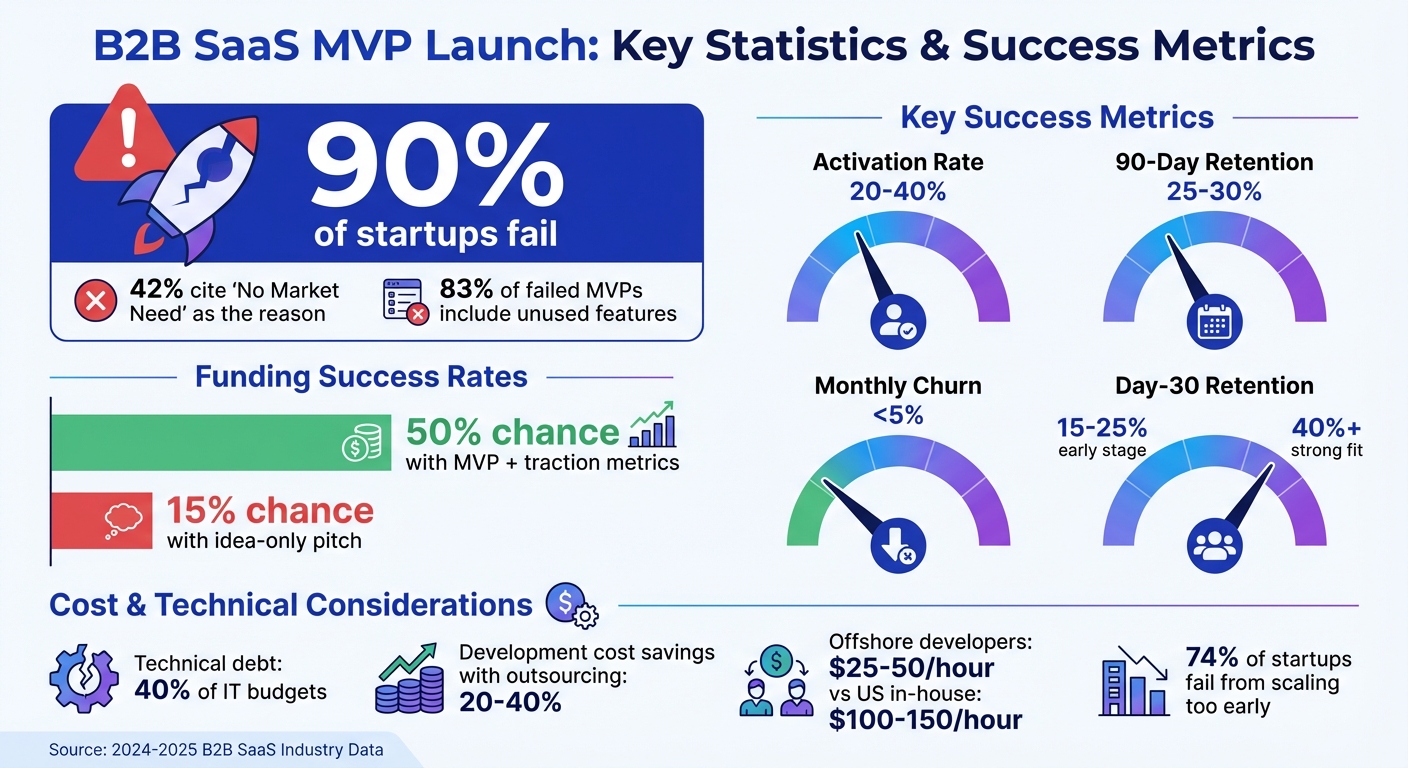
B2B SaaS MVP Launch Statistics and Key Metrics for Success
SaaS MVP Development Best Practices All Top SaaS Companies Follow
Define Your MVP Scope with Clear Priorities
The toughest part of creating an MVP isn’t about writing code - it’s about deciding what not to include. A staggering 42% of failed startups point to "No Market Need" as their downfall, often because they built features no one cared about. The key? Pinpoint one urgent problem that users value enough to pay for, and then cut 80% of the planned features.
To stay focused, start by zeroing in on a single primary user persona. Trying to appeal to "everyone" only waters down your product. Next, map out the simplest, most direct path from sign-up to the "aha moment" - that magical point where users grasp the product’s value. Keep this journey so simple that core tasks can be completed in three clicks or fewer.
Take this example: In 2025, an HR tech client partnered with EnactOn Technologies. Initially, they planned to include ten onboarding features. After analyzing the user journey, they narrowed it down to one critical feature: automated ID verification. The product launched in just two months, solving a major pain point and immediately drawing in users.
Use Prioritization Frameworks to Stay Focused
Prioritization frameworks are your best friend when it comes to filtering out unnecessary features. The MoSCoW method is a simple yet effective approach: classify features as Must-have (essential for launch), Should-have (important but not critical), Could-have (nice-to-have), or Won’t-have (excluded from the MVP). Another popular option is RICE scoring, which evaluates features based on Reach, Impact, Confidence, and Effort, helping you make data-driven decisions.
For B2B SaaS projects, the Impact vs. Effort Matrix is particularly helpful. It highlights "Quick Wins" (high impact, low effort) that deserve priority while flagging "Thankless Tasks" (low impact, high effort) that waste resources. Focus on 1–2 primary use cases and avoid getting bogged down by edge cases or admin tools during the initial launch. This level of precision now saves you from unnecessary development later.
Align MVP Goals with Business Objectives
An MVP isn’t just about the product - it’s about validating your business model. The Lean Canvas methodology can help ensure your product vision matches your revenue model and market niche from day one. Decide early if you’re going with freemium, subscription, or usage-based pricing, as this will shape which core features you need to prioritize.
To sharpen your focus, answer these three questions: Who is your primary user? What are their top three pain points? Which one is urgent enough that they’d pay for it right now? Testing pricing early can help you separate genuine demand from casual interest. In 2024, startups with an MVP and at least one solid traction metric had a 50% chance of closing seed funding, compared to just 15% for startups still in the "idea-only" phase.
"If you're not embarrassed by the first version of your product, you've launched too late." - Reid Hoffman, Co-founder of LinkedIn
At this stage, speed matters more than perfection. Choose tools and frameworks that allow for the fastest possible launch instead of focusing on long-term scalability. For instance, a fintech client working with EnactOn Technologies initially wanted a product with multi-currency invoicing and analytics. After narrowing the scope, they launched with just one feature: automated GST compliance for Indian businesses. The product hit the market in four months and quickly attracted paying users.
Core Features to Include in a B2B SaaS MVP
When building a B2B SaaS MVP, the key is to focus on features that combine security, functionality, and performance. The primary objective? Solve a single, pressing problem while meeting the baseline expectations of B2B buyers.
User Authentication and Role-Based Access Control (RBAC)
Strong data protection is non-negotiable for B2B buyers. Features like multi-factor authentication (MFA), regular password updates, and encryption are essential to safeguard sensitive information. Beyond basic login capabilities, role-based access control (RBAC) is critical for managing permissions within organizations. For instance, a marketing manager shouldn’t have the same access privileges as a finance director.
To simplify implementation, consider third-party tools like Firebase, Supabase, or Auth0. These platforms offer scalable authentication and real-time data storage, freeing up your team to concentrate on building the core product. Also, ensure your authentication process complies with standards like GDPR or SOC 2, as these are often the first indicators of reliability that B2B users evaluate. Once you’ve secured robust access controls, shift your focus to solving your users’ main problem.
Core Problem-Solving Functionality
Your MVP should prioritize the must-have features that directly address your target users’ biggest pain point. The goal is to excel at one thing rather than dilute your product by tackling too many issues at once.
Performance is just as important as functionality. Your system should respond in under 300 milliseconds - users might forgive a limited feature set, but they won’t tolerate slow or unstable performance. If your core feature involves complex backend processes, you might start with a Concierge MVP, where manual processes are used to validate demand before fully automating the solution. Once the core functionality is in place, your next step is to monitor performance and enhance security with analytics.
Basic Analytics and Security Foundations
Analytics are essential to track how users interact with your product. Tools like Mixpanel, Google Analytics, or Hotjar can help you monitor key metrics such as Activation Rate (the percentage of users who complete a critical first action). Other important metrics include Day-30 Retention and Churn Rate, which reveal whether users are gaining real value from your product.
On the security side, adopt a DevSecOps approach to integrate cybersecurity into every stage of your development process, rather than treating it as an afterthought. Solid data on activation and retention can also attract investors - startups with an MVP and meaningful traction metrics have a 50% chance of closing seed rounds, compared to just 15% for idea-only pitches.
Choose the Right Technology Stack and Development Approach
The technology stack you choose for your MVP (Minimum Viable Product) plays a huge role in how quickly you can launch and how well your product can grow in the future. A well-chosen stack balances speed, cost, and flexibility. On the other hand, a poor choice can lead to technical debt, which could eat up as much as 40% of your IT budget. Making smart decisions here sets the foundation for a scalable and efficient technology strategy.
Key Considerations for Technology Selection
When building an MVP, focus on technologies that let you deliver core functionality quickly. An API-first approach is a smart way to go, especially since B2B buyers expect your platform to work seamlessly with existing tools like CRMs, HRIS systems, and payment gateways.
For backend development:
- Node.js with PostgreSQL is ideal if you need high throughput and real-time performance.
- Django with PostgreSQL works well for analytics-heavy or workflow-driven applications, thanks to its rapid CRUD (Create, Read, Update, Delete) capabilities and built-in admin tools.
For frontend development:
- React offers great flexibility for building complex interfaces.
- Vue is a good choice for quick prototyping.
Instead of diving straight into microservices, consider starting with a containerized monolith. While microservices offer long-term flexibility, a monolithic architecture simplifies the early stages of development, letting you focus on validating your product-market fit.
You can also save time and money by using managed services and third-party APIs. Tools like Auth0 for authentication, Stripe for payments, and Twilio for messaging allow your team to concentrate on creating unique value for your product. This approach can cut development costs by 20–40% compared to building everything from scratch.
In-House Development vs. Partnering with Experts
Once you’ve chosen your tech stack, the next step is deciding how to build your product. Developing in-house gives you full control, but it comes with significant overhead, including long hiring processes and higher salary expenses.
Outsourcing, on the other hand, offers faster deployment. Experienced development teams come ready to work with proven frameworks, eliminating the need for lengthy hiring cycles. Outsourcing also gives you access to specialized skills, so your internal team can focus on business strategy.
"Innovation in large organizations rarely starts with a massive rollout. More often, it begins with a simple idea... But turning that idea into a working product can be slow and resource-heavy, especially within complex enterprise environments." - Volodymyr Lytvynchuk, Head of Cluster, N-iX
Cost is another key factor. Offshore developers typically charge $25–$50 per hour, while U.S.-based in-house developers cost between $100–$150 per hour. By outsourcing, you could reduce upfront development costs for a SaaS MVP by 30–50%. Plus, startups with an MVP and strong traction metrics have a 50% success rate in securing seed funding, compared to just 15% for those with only an idea.
If you’re aiming to launch quickly to seize a market opportunity, working with an experienced development firm can provide the speed and flexibility you need. Outsourcing allows you to scale your team up or down as needed for each sprint, without the long-term commitment of hiring full-time staff - a huge advantage during the early validation phase.
Implement Quality Assurance and Testing
After making strategic decisions about development and your tech stack, the next critical step is quality assurance (QA). QA ensures your product functions as intended, safeguards your reputation, and keeps you from over-complicating things. The goal? To make sure your core features perform reliably and consistently.
Automated and Manual Testing Approaches
A solid testing strategy blends automated and manual methods.
Automated testing is perfect for repetitive tasks and checking technical stability, especially as your product scales. Tools like Playwright or Cypress are excellent for integration testing. These tools help you spot issues when different parts of your system interact and work seamlessly with CI/CD pipelines, enabling quick fault detection.
On the other hand, manual testing shines when it comes to usability and catching edge cases that automation might overlook. Start with hallway testing, where teammates or non-experts attempt to complete key tasks. This informal method can quickly highlight whether your interface feels intuitive or confusing. Always use real data during these tests instead of placeholder text like "lorem ipsum." Placeholder content can feel artificial and prevent testers from engaging authentically with your product.
Security testing is another essential component of QA and should be integrated from day one. Automated checks for multi-factor authentication (MFA), role-based access control (RBAC), and encryption are must-haves. These measures help you meet standards like ISO/IEC 27001 or GDPR. Beyond compliance, these security steps build trust with enterprise clients who are cautious about data security on new platforms.
"Done is better than perfect, but validated is better than just done." - Murtuza Kutub, Product Development Expert, F22 Labs
These QA practices lay a strong foundation for refining your MVP and preparing for real-world use.
Testing with Early Users
Once internal testing wraps up, it's time to bring in real users. Even a small group of 5–10 active users can reveal major flaws and confirm whether your product delivers on its promise. For more statistically meaningful insights, aim for 50–100 users - but don’t let the need for perfect data delay your launch.
Session replay tools are incredibly helpful during this phase. They allow you to see exactly how users interact with your platform, revealing bugs and usability issues that might otherwise go unnoticed. Pair this with AI-powered micro-surveys that pop up after key actions to ask questions like, "Was this what you expected?" These quick surveys capture friction points in real-time without the need for lengthy follow-ups.
You could also consider beta testing with a group of users that closely matches your target audience. Use targeted Facebook or search ads to recruit participants, which also gives you valuable insights into early customer acquisition costs. Set clear benchmarks, such as achieving a 25–30% activation rate or receiving responses from over 20% of your email waitlist. This approach ensures your decisions are based on real data, not guesswork. The feedback you collect here will guide your next steps and help you refine your product further.
sbb-itb-116e29a
Set Up Pre-Launch Analytics and Tracking
Before your MVP goes live, it's essential to establish an analytics system that captures user behavior from the start. This setup will help you identify what’s working, what’s broken, and where users find value. Don’t worry - you don’t need a fancy or overly complex system. A well-chosen combination of tools can provide the insights you need to validate your product-market fit and guide your next steps.
Start with the basics: use GA4 for tracking user behavior and GTM to manage scripts and collect key data. Then, add a product analytics tool like Mixpanel or Amplitude to track specific actions, build conversion funnels, and analyze user cohorts.
For deeper insights into user interactions, tools like Hotjar or FullStory are invaluable. Heatmaps and session recordings can reveal friction points that raw numbers might miss - like users repeatedly clicking on a non-functional button or abandoning a form halfway through.
Before implementing any tracking, create a clear plan using the "Object-Action" framework (e.g., "User Signed Up" or "Report Generated"). A simple spreadsheet outlining these events ensures your engineering team knows exactly what to track, avoiding messy or incomplete data. Use the MoSCoW method (Must-have, Should-have, Could-have, Won’t-have) to prioritize key events for launch. Instead of trying to track everything, focus on 2–3 core features - this approach, often called Minimum Viable Analytics (MVA), keeps your data manageable and actionable. With this foundation, you’ll be ready to define meaningful SaaS KPIs.
"Without data on how the user is moving through your product, you won't grasp where they're unlocking the most value. Without those insights, your team and product devolve into conjecture and building for the vocal minority." - Sam Richard, Director of Growth, OpenView
Define Key SaaS KPIs
Once your tracking is in place, the next step is to define the KPIs that will measure your MVP’s success. For a B2B SaaS MVP, focus on metrics that show whether users are finding value and staying engaged.
One of the most important early indicators is the activation rate - the percentage of users who reach their "Aha moment." For example, this could be when a user creates and shares their first report on your platform. Use interviews and session recordings to pinpoint this moment, then track how many new users hit this milestone during their first session or week.
Retention metrics are equally critical. Day-30 retention - the percentage of users still active 30 days after signing up - can signal long-term viability. A good early-stage target is 15–25%, while 40% or higher suggests strong product-market fit.
Another key metric is the monthly churn rate, which measures the percentage of customers canceling each month. Aim to keep this below 5% to maintain sustainable growth. Pair churn data with Time-to-Value (TTV), which tracks how quickly users achieve their first activation. A shorter TTV typically means a smoother user experience and better retention.
Here’s a quick reference for key benchmarks:
| Metric | Target Range | Why It Matters |
|---|---|---|
| Activation Rate | 20–40% | Shows if users quickly experience core value |
| 90-Day Retention | 25–30% | Indicates long-term product-market fit |
| Monthly Churn | < 5% | Essential for sustainable growth |
| Landing Page Bounce Rate | 40–60% | Evaluates effectiveness of initial messaging |
Set SMART goals (Specific, Measurable, Actionable, Realistic, and Timely) for each metric. For instance, instead of vaguely aiming for "more signups", set a clear target like "1,000 signups in the first month with a 25% activation rate." This clarity helps you evaluate success and refine your strategy using real data. With your KPIs defined, use analytics and heatmap tools to track and optimize these metrics.
Use Product Analytics and Heatmap Tools
Product analytics tools like Mixpanel and Amplitude are perfect for tracking user actions and building conversion funnels. These funnels show where users drop off in key workflows, providing actionable insights. For example, you might discover that completing a specific onboarding step dramatically boosts retention - highlighting an area to improve.
These platforms also let you segment users into cohorts, such as those who activated in their first week versus those who didn’t. Comparing these groups can uncover patterns and guide product decisions. Additionally, server-side tracking for critical events (like a "Subscription Upgraded" signal) ensures accurate data, even if users have ad-blockers enabled.
Heatmap and session recording tools like Hotjar or FullStory add a visual layer to your data. Heatmaps reveal which areas of a page draw the most attention, while session recordings show how users navigate your platform. This can expose usability issues, such as confusing navigation or broken links, that might otherwise go unnoticed.
To simplify your data infrastructure, consider using a Customer Data Platform (CDP) like Segment. A CDP acts as a central hub, sending data to multiple analytics tools through a single API. This ensures consistency and reduces setup complexity. Use consistent UTM parameters (e.g., utm_source=linkedin&utm_medium=paid&utm_campaign=launch_week1) to track marketing channels effectively. Finally, set up automated dashboards to monitor your core KPIs and make quick, informed decisions as you refine your MVP.
Launch Strategy and Early Adopter Engagement
Getting your MVP into the hands of real users is crucial, but the trick is to focus on a few impactful channels rather than trying to be everywhere at once. This targeted approach helps you get the most out of your efforts while giving you clear insights into what’s working. For a B2B SaaS MVP, a soft launch is often the way to go. By introducing your product to a smaller, targeted group of early adopters, you can test for product-market fit without the pressure of a full-scale public launch.
Start by figuring out where your ideal users already spend their time. For B2B SaaS, platforms like LinkedIn, Product Hunt, and niche Reddit communities are excellent places to find early adopters. Build a pre-launch landing page to collect email addresses from interested users, giving you a waiting list before the product is live. Sharing updates on social media is another great way to build credibility and attract attention.
"The right time for startup founders to begin selling their products is after they have built an audience and established trust with them." - TK Kader, Founder, Unstoppable
Once you’ve nailed down your channels, launch a coordinated campaign that spans multiple platforms. Use a mix of PR outreach, social media posts, live webinars, and email campaigns to boost visibility. Webinars are particularly effective - 92% of attendees find the Q&A portion highly valuable. Keep your messaging laser-focused on the core problem your product solves, rather than overwhelming people with long feature lists. This soft launch not only helps validate your product but also lays the groundwork for scaling later.
Leverage Multi-Channel Marketing Efforts
Stick to the platforms where your target audience is already active. For B2B SaaS, this often includes LinkedIn for professional networking, Slack or Discord communities for direct engagement, and content marketing (such as blogs or podcasts) to attract potential customers in the awareness stage.
On LinkedIn, focus on building trust by sharing insights and engaging in industry discussions before jumping into direct outreach. This consultative approach - where you listen to users’ workflows and pain points - creates stronger relationships and leads to better conversion rates than cold pitches.
For broader exposure, consider launching on Product Hunt or similar platforms. These launches work best if you’ve already built momentum through other efforts. Get your community involved ahead of time - encourage early adopters to show support on launch day, which can significantly amplify your reach. Pair this with email campaigns to your waiting list, offering early-access perks like discounts or extended free trials to drive sign-ups.
Another powerful tactic is to share original insights. Conduct surveys or analyze industry data to create reports that position your brand as a trusted authority. Distribute this content across multiple channels - blog posts, LinkedIn articles, webinars, and newsletters - to create a steady stream of inbound interest.
Engage with Early Adopters
Once you’ve generated interest, the next step is turning those early adopters into engaged partners. These users are more than just testers - they’re collaborators who can help you refine your product. Make them feel like insiders by offering personalized outreach. Early on, prioritize personalized onboarding and one-on-one interviews to gather meaningful feedback.
"Especially in the early days, the relationships you build can be your most valuable assets. These relationships can lead to referrals, partnerships, and repeat business." - William Ballance, Co-founder and CEO, Lavender
Set up dedicated communication channels, like a private Slack group or Discord server, where your early adopters can share feedback, ask questions, and interact directly with your team. Regular Zoom meetings with these users can provide critical insights and strengthen your relationship with them.
To encourage participation, offer incentives like lifetime deals (30–50% off), extended free trials, or discounted early-access pricing. Referral programs are another excellent way to generate warm leads and test your product’s potential for organic growth. Remember, existing customers tend to spend about 67% more than new ones, so nurturing these early relationships can pay off significantly.
Transparency is key during this phase. Share your roadmap openly, explain what’s coming next, and show how user feedback is influencing your decisions. Even if your MVP isn’t perfect, users who feel valued and heard are more likely to stick around and become loyal advocates for your product.
Post-Launch Iteration and Feedback Loops
Once your product is live, shift your focus from defending past decisions to figuring out what needs to change. 70% of MVP clients pivot at least once after early testing. The quicker you adapt based on real user behavior, the better your chances of creating something people are willing to pay for.
Collect and Prioritize User Feedback
Skip generic surveys and go straight to detailed conversations with early users. These interviews can uncover the "why" behind user actions - what they were trying to achieve and where they encountered issues. This kind of insight often highlights pain points that raw analytics might overlook.
Pair these qualitative insights with quantitative data, such as analytics, churn rates, and Net Promoter Scores, to get a complete picture of how your product is performing. Make it simple for users to share their thoughts by including a "Share Feedback" button in your app. Use a feedback management tool to keep everything organized.
Focus on patterns in the feedback that align with your main goals. Isolated complaints or one-off issues can usually wait. Use prioritization frameworks like MoSCoW or RICE to decide which improvements to tackle first. Combine these insights with your data to guide your next steps.
"Smart founders build MVPs not to launch fast, but to learn fast." - Paresh Mayani, CEO, SolGuruz
Use Data-Driven Insights for Next Steps
Take what you’ve learned from user feedback and dig deeper into user flows. Look for areas where users drop off, such as during onboarding or critical actions.
Keep an eye on cohort retention metrics. A Day-30 retention rate above 15% and activation rates over 25% are strong signals that your product is ready to scale. If you’re not there yet, keep refining the core experience.
Stick to a Build-Measure-Learn cycle with sprints lasting 2–4 weeks. This approach keeps your team nimble and ensures regular progress checks. To minimize risk, use feature flags to roll out updates to small user segments first. This way, you can gather valuable data on changes without disrupting the entire user base.
Scaling Beyond the MVP Stage
Once your MVP has shown consistent engagement, it's time to shift gears and think about scaling. This phase demands a strong infrastructure and smart strategies to support growth. The key? Stay focused. Avoid the temptation of overloading your product with unnecessary features and instead, invest in a foundation that can handle increased demand.
Prepare the Codebase and Systems for Scalability
Begin with a modular monolith - a structure where different components, like billing or user accounts, are loosely connected. This setup allows for quick early development while keeping the door open for future upgrades. As Mike Jackowski, Co-Founder of ASPER BROTHERS, puts it:
"If one part of the app needs to be rebuilt or split later, can we do it without breaking everything else?"
Stick to reliable tech stacks like React, Node.js, Python, and PostgreSQL for scalability. To lighten your load, use trusted providers like Stripe or Auth0 for handling security and compliance.
Set up CI/CD pipelines and adopt proactive monitoring tools like Sentry or Datadog to make testing, deploying, and troubleshooting seamless. Cloud services from providers like AWS, Azure, or GCP can handle elastic scaling and automated load balancing. For performance, caching tools like Redis are excellent for distributing traffic evenly.
Technical debt is a major cost - studies show it can take up roughly 40% of IT budgets, with an additional 10%-20% spent managing it. Addressing these issues now will save you from expensive rework down the line.
Once your technical groundwork is solid, the next step is optimizing how you attract and retain users.
Build Growth Funnels and Iterate on Features
Focus on the "Golden Path" - the shortest and most effective route from user sign-up to that "aha" moment when they see your product's value. Ensure this journey is as smooth as possible before adding extra features. For example, design helpful empty states that guide users on what to do next when no data is available, reducing early friction.
Encourage organic growth by incorporating simple referral systems, like an "Invite a teammate" button, and use A/B testing to fine-tune onboarding or feature placement. To ensure long-term success, aim for a Customer Lifetime Value (CLTV) that's at least three times your Customer Acquisition Cost (CAC).
Maintain a steady rhythm: set weekly goals, build midweek, and ship by week's end. As Mike Jackowski explains:
"A scalable MVP isn't only about the features themselves, but also about the business flexibility built into the product"
Strive for balance - keep your core product stable while gradually introducing new features. Simplicity wins here; intuitive products are more likely to be shared and recommended. Use frameworks like MoSCoW or the Kano model to evaluate feature requests, ensuring they align with your overall goals.
Scaling isn't just about adding users - it's about creating a product that resonates across different user groups, not just your early adopters. Keep this repeatability in mind as you grow.
Conclusion
Launching a B2B SaaS MVP isn’t about crafting a flawless product - it’s about putting your assumptions to the test and sidestepping costly missteps. Here’s a sobering fact: 90% of startups fail, often because they create products no one really needs. A well-thought-out MVP can shift those odds. In 2024, startups with an MVP and measurable traction had a 50% chance of securing seed funding, compared to just 15% for those pitching mere ideas. These numbers highlight how critical it is to make every decision in your MVP strategy count.
The way forward? Focus relentlessly on solving your core problem, design with scalability in mind from the start, and set up feedback loops to guide your path. As EnactOn Technologies aptly puts it:
"The MVP stage does not just test ideas, it prevents costly mistakes. With the right approach, it becomes a launchpad instead of a detour".
Keep in mind that 74% of startups fail due to scaling too early. Patience, paired with thorough validation, is your best ally.
Your MVP lays the groundwork for future growth. Build it with a strong architecture, prioritize early security and compliance, and use pricing to confirm demand. Considering that technical debt eats up about 40% of IT budgets, addressing these aspects now will save you from expensive fixes down the road.
An MVP is more than just a stripped-down product - it’s a strategic experiment to test your core hypothesis with minimal resources. Start small, learn quickly, and focus on what users truly need to transform your MVP into a successful B2B SaaS platform.
FAQs
Why do B2B SaaS MVP launches often fail?
B2B SaaS MVP launches often stumble because of misaligned objectives, overly complex designs, and poor follow-through. A major pitfall is treating the MVP as a finished product rather than an experiment. This mindset often leads teams to skip essential steps, like outlining clear hypotheses, defining success metrics, and setting criteria for failure. Without these, it becomes nearly impossible to determine if the solution genuinely solves a market problem.
Another frequent issue is scope creep - packing in extra features before confirming whether the core problem has been addressed. Even the most polished product will fail if it solves the wrong issue. On top of that, skipping real-world testing or relying on mock data can mask usability problems that only emerge later when it’s too late to course-correct.
Other common mistakes include insufficient quality assurance, weak feedback loops, and failing to align the MVP with broader business goals. To improve the odds of success, teams should focus on keeping the scope tight, prioritizing feedback from real users, and establishing clear, measurable goals from the start.
How do I decide which features to include in my B2B SaaS MVP?
Choosing the right features for your B2B SaaS MVP is all about balancing value and efficiency. Start by pinpointing the main problem your platform solves and the key result it delivers to your target users. The features that tackle this head-on should take precedence, while less critical ones can be saved for later updates.
To decide which features make the cut, assess each one based on its business impact (like revenue potential or user satisfaction) and the effort required to build it (such as complexity or time investment). Tools like the MoSCoW framework (Must-have, Should-have, Could-have, Won’t-have) or an impact-effort matrix can help you prioritize effectively. Once you’ve narrowed down your list, validate your choices by engaging with early users through surveys, interviews, or testing prototypes. Their feedback ensures your features align with actual user needs.
Focus on delivering the most critical features within a short development window - ideally 6 to 8 weeks. This approach allows you to launch quickly, gather user insights, and refine your product, all while staying on track with your goals and budget.
How can I effectively engage early adopters during a soft launch for my B2B SaaS MVP?
Engaging early adopters successfully starts with treating them as partners in the process, not just end-users. Begin by selecting a group of users who closely match your ideal customer profile. Be upfront about the goal of the soft launch - testing assumptions and fine-tuning the product - and make their onboarding seamless. Tools like guided tours, quick-start guides, or even personal welcome calls can help them quickly see the product's value, encouraging open and honest feedback.
Create straightforward ways for them to share their thoughts. Options like in-app surveys, short questionnaires, or private forums work well for gathering input. Respond to their feedback quickly and focus on addressing common or pressing concerns. This back-and-forth not only improves the product but also builds trust with your early users.
To keep them invested, consider offering perks like early access to new features, sneak peeks, or even credits for completing feedback tasks. When users see their ideas shaping product updates, they’re more likely to stick around and become advocates, boosting your launch and offering insights that can shape future development.